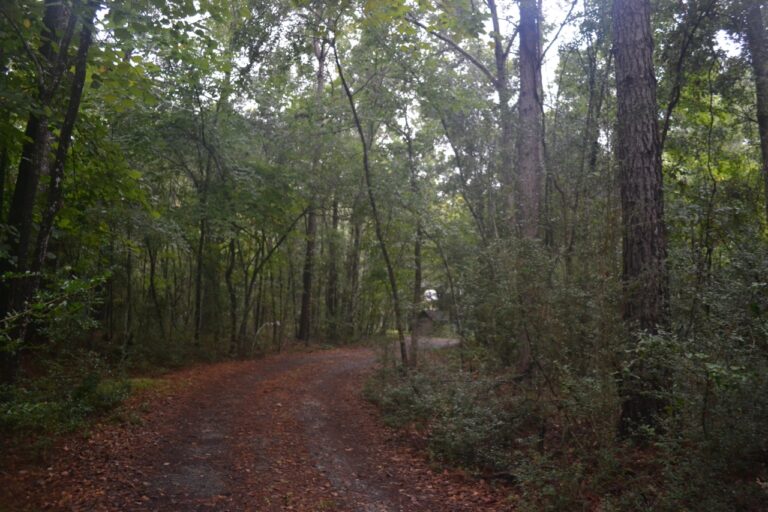
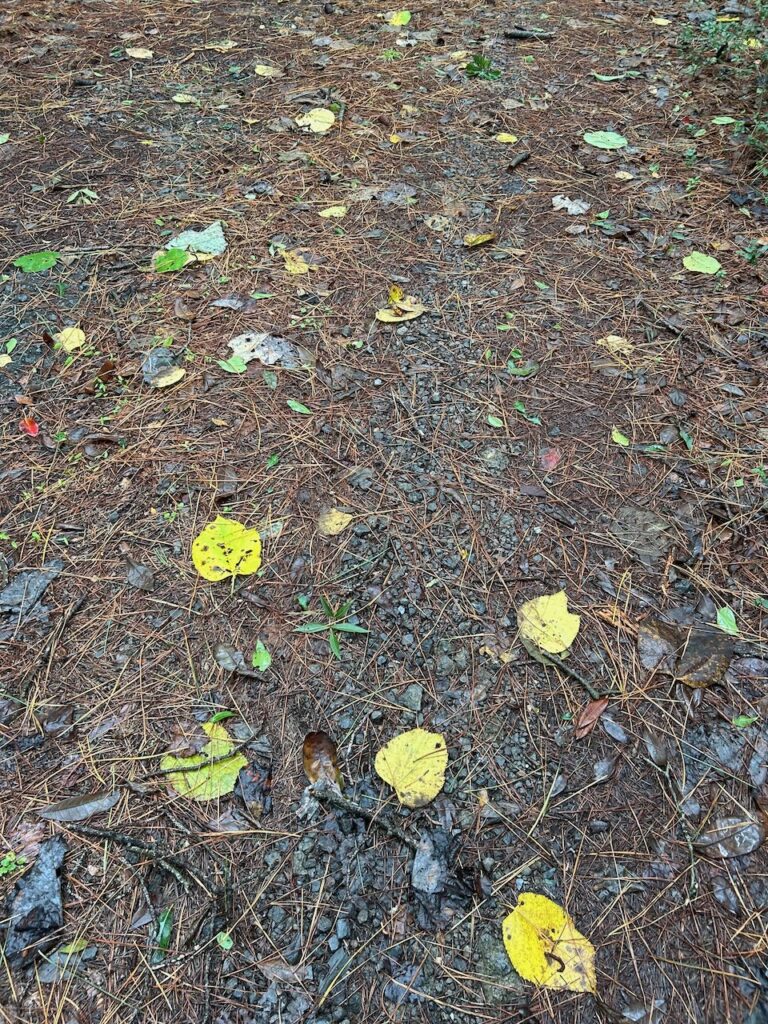
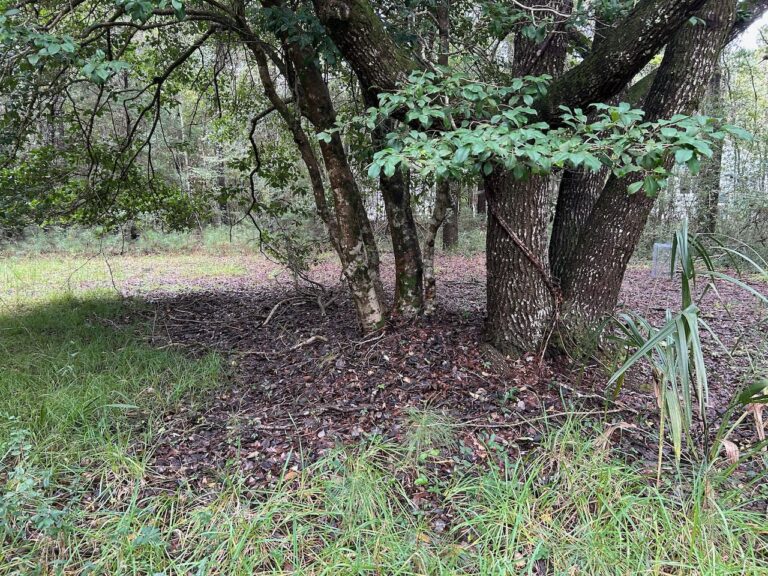
I started off on the well worn path, one I have walked many times. It curves through a mature forest of oaks: live, laurel, and water; loblolly pines, mockernut hickory, southern magnolia, sweet gum, black gum (sour gum or black tupelo),and red mulberry. Sprinkled in these woods are dogwood, American holly, black cherry, and red maple. In late October some of the leaves have begun to fall and change color, particularly the large leaves of the mulberries, littering the walkway. As the path continues toward the southeast, a slight elevation change occurs, and this subtle descent is marked by dwarf palmettos along the path in the understory mostly dominated by yaupon holly. Indigenous peoples in the southeast made a tea with the yaupon leaves – “black drink” for spiritual purposes, this shrub which can grow to small tree size. The turn around for this hike is our mail box, since this walkway is the driveway on our property. We purchased this 3.5 acres of land in 1980 as the site where I would build our house. To start, I laid out the drive and house site, and cut down the trees and shrubs.
Besides removing trees I have planted a number of trees, and planting a tree creates a special relationship with that plant – we have named a few of our trees. I had a friend, Terry Cumbee, who had his own nursery, and who gave me several trees over the years. I had wanted a red cedar, and Terry was bringing it to Awendaw coming from his nursery near Georgetown. His dog Santee was riding in the bed of the truck with the cedar, and as he was passing over the Santee Delta he noticed sprigs of the tree were blowing out of the truck. He found that Santee was chewing off branches. So this tree became the Santee cedar, and is a fine mature Eastern red cedar. Terry passed away well before his time. I talked to his brother-in-law, Clary Dawson, to see if I could purchase a live oak from Terry’s nursery for a special planting on our property. Clary found one and gave it to us – we now know it as the Dawson oak.
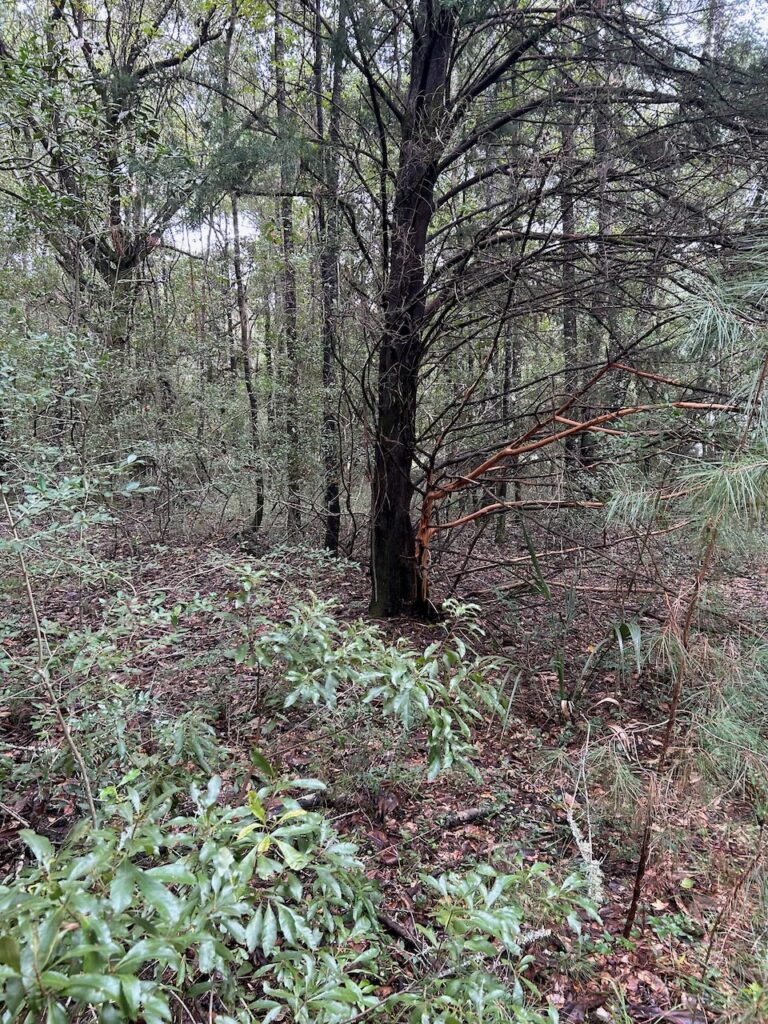
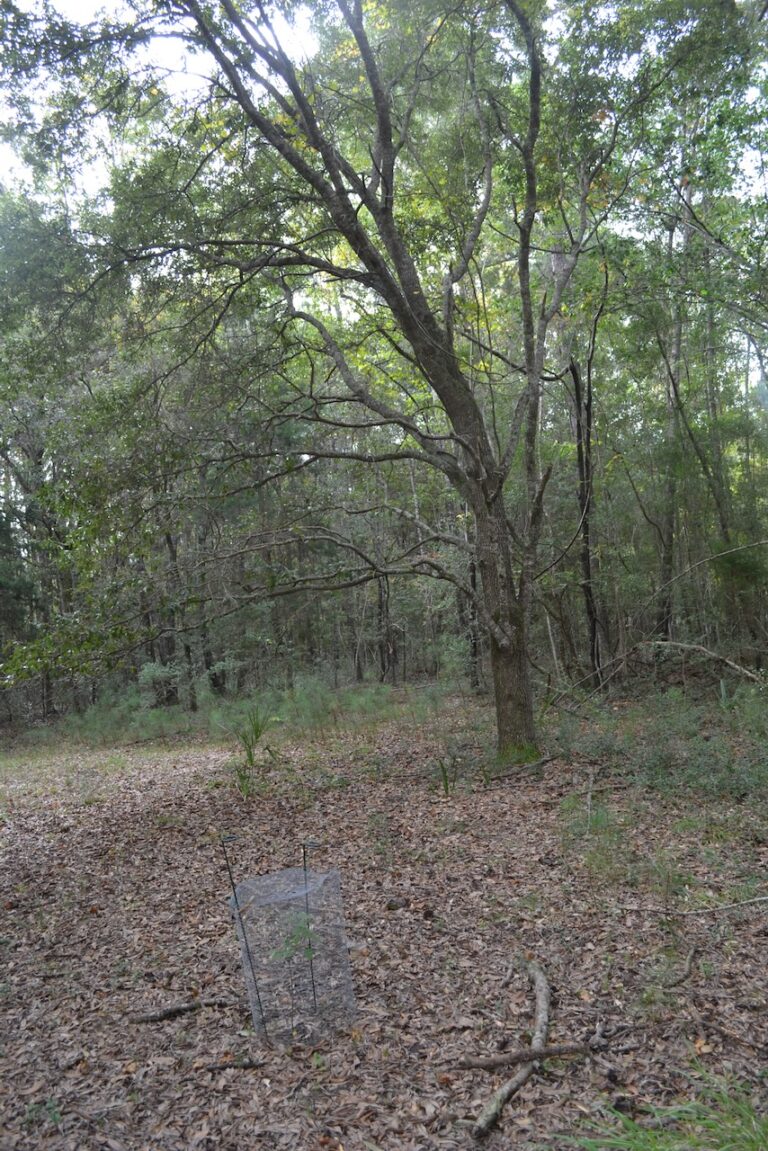
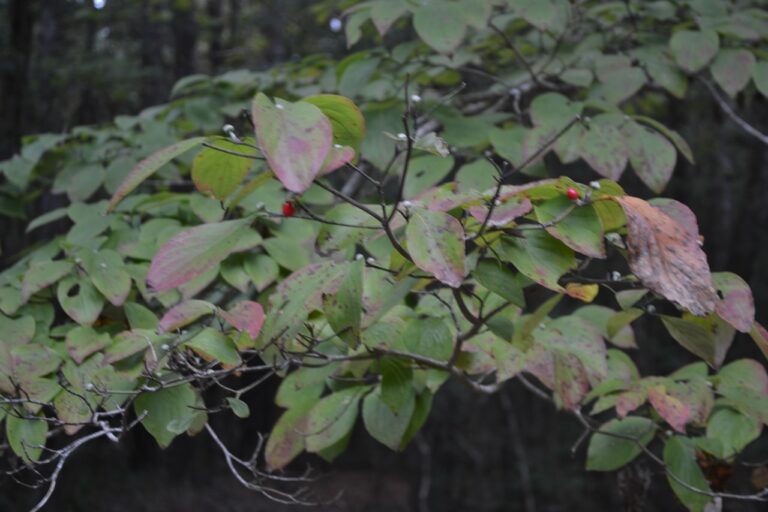
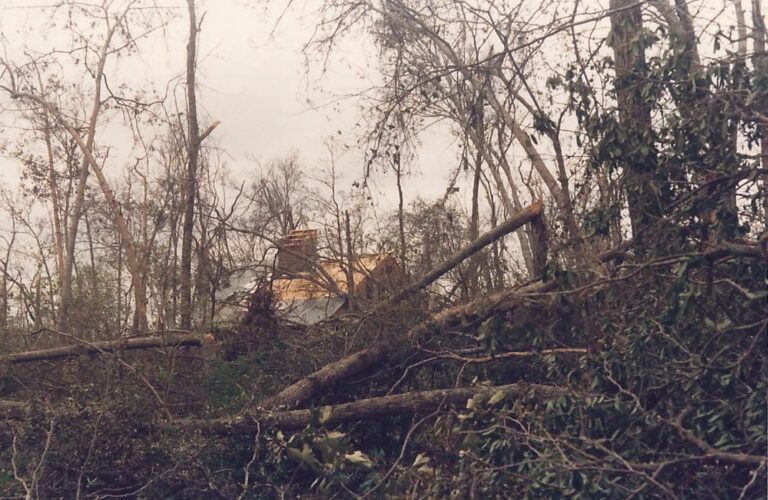
One of the beauties of our property that we discovered after the purchase was the understory filled with flowering dogwoods. Both in spring when the flowering was at a peak, and fall when the leaves changed to their fine hues, were times when our woods became a stunning wonderland. After Hurricane Hugo devastated the forests of Awendaw, many of our mature trees came down (the oaks uprooted, the pines sheared off), and we felt relieved our dogwoods stood. However within the next week after the storm surge covered our property, the salt water killed the dogwoods. We planted several dogwoods in the aftermath, but have noted in recent years the regeneration of a few dogwoods (from root stock or seed?), one of those young ones along the driveway and leaning out into the path through the woods. Rather than prune the tree, I tethered it away from the drive. The resilience of our forest has been more than we could have hoped.
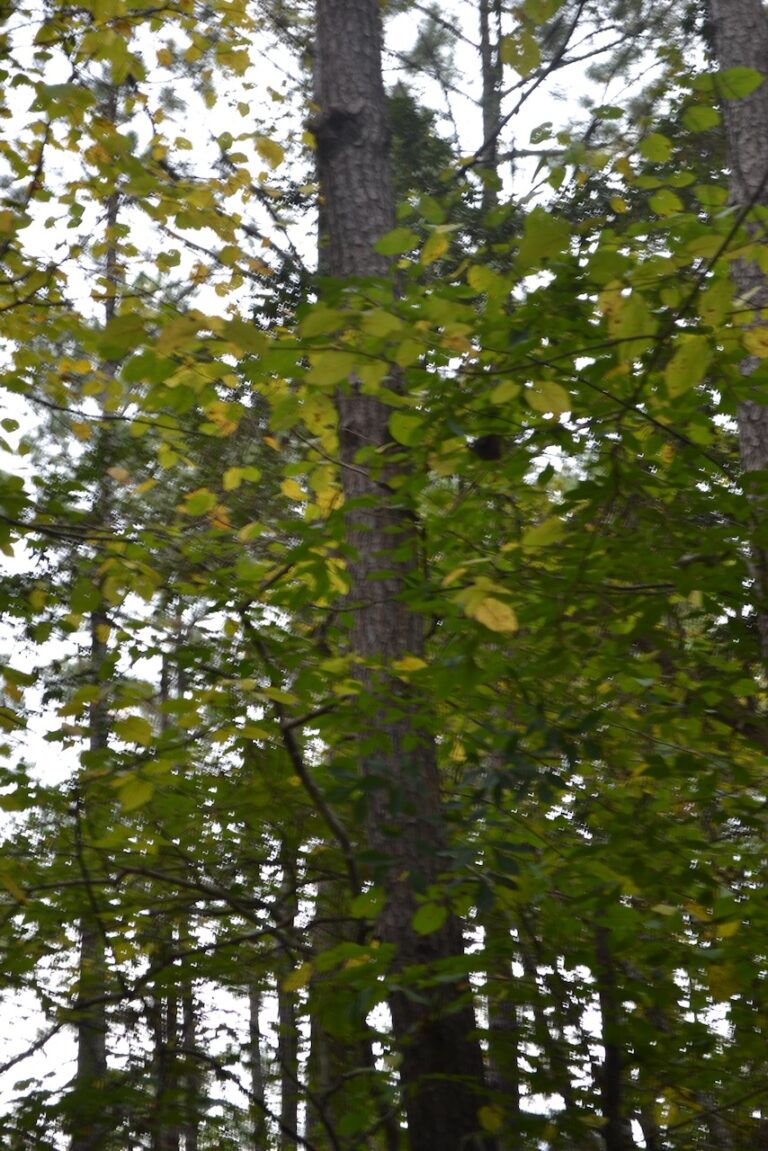
A tree appearing in the forest regeneration was one I didn’t recall from the early days living here, perhaps it was overshadowed by the dogwoods and major trees of the overstory. Currently some of its large heart-shaped leaves are turning yellow and falling. With help in the identification (thank you Mike Prevost), it is red mulberry, located in the midstory of the forest.
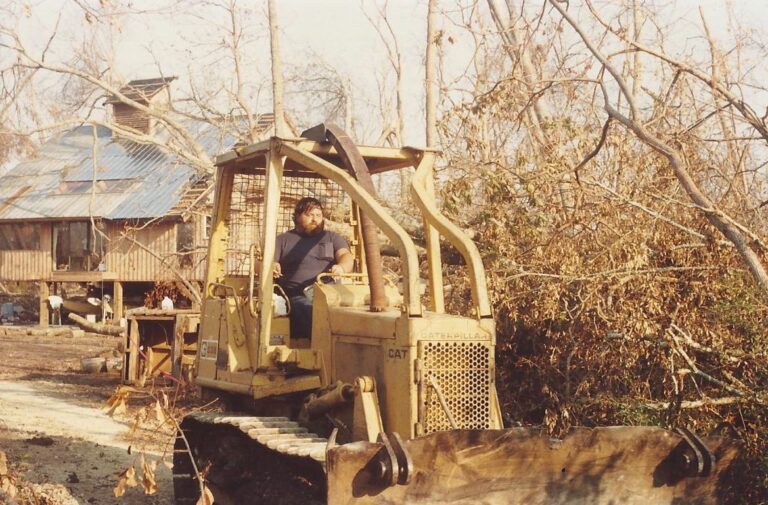
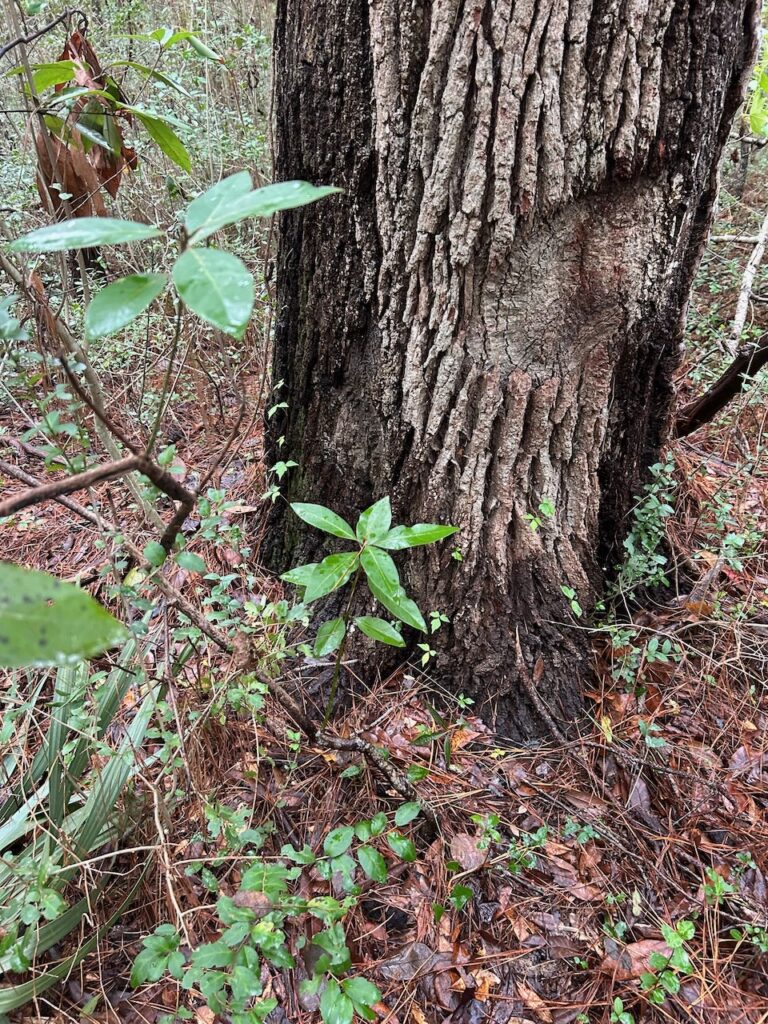
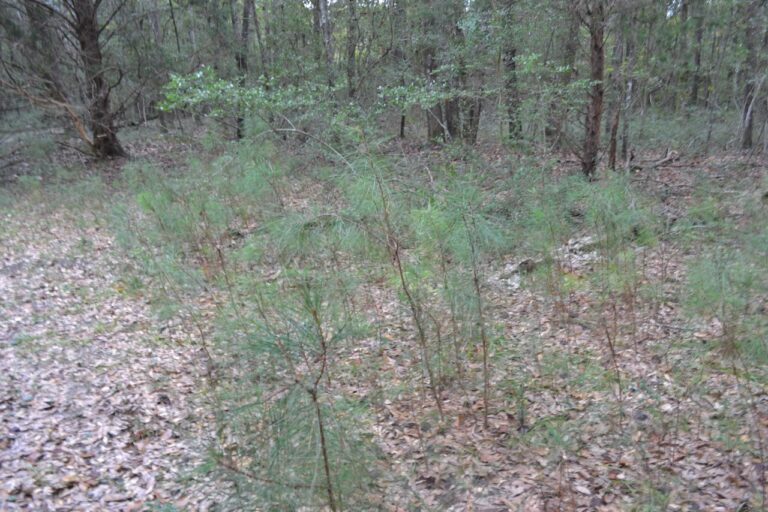
Another sign of Hugo further down the drive is a scar on the trunk of the largest live oak on our property. Due to the number of trees blocking our driveway and those on our house, we hired a crew to clear the trees.The lead man, known as “Bear”, operated a small bulldozer, and the scar on a major live oak on the edge of the driveway is surely an artifact from his work. A few years ago a dead loblolly pine just off the drive was the location for pileated woodpecker nest holes (see Along the Driveway). The tree finally came down in a tropical storm, but we have many more loblollies on the property. After Hugo, Terry Cumbee dropped by one day with about fifty loblolly seedlings and a hoedad to facilitate the planting, and directed us (my father and me) to get to work. We did but it was not really necessary since loblollies seed themselves so prolifically. A good example of this process took place in an area where I decided to not mow anymore. Last winter I began a project to turn this plot into a small wildflower meadow, and starting pulling up loblollly seedlings, perhaps two hundred in a few hours.
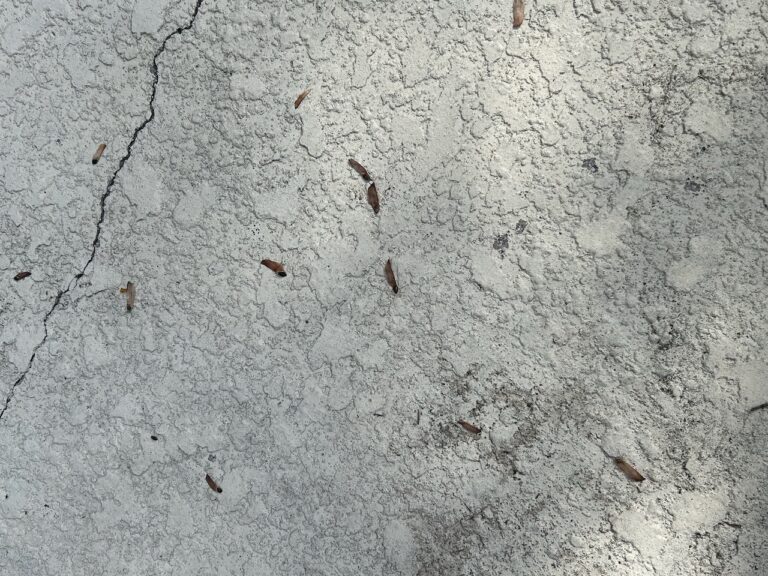
I have learned to appreciate loblolly pines. Their ability to proliferate is impressive – their dispersal of seeds is illustrated by the below photo of a scattering of seeds on a concrete deck. Their rate of growth is rapid, and in our regenerated forest their height has reached to the top of the canopy since 1989.
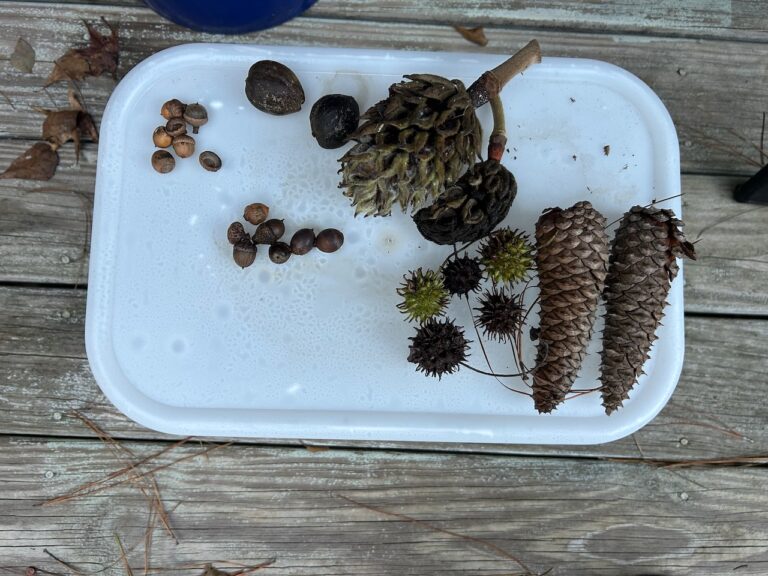
Speaking of seedlings, the trees of the forest have a diversity of seed dispersal devices, and the following photo captures an assembly of these seed carriers (live oak acorns, laurel oak acorns, hickory nuts, magnolia seed pods, sweet gum balls, loblolly pine cones). I recently read Douglas Tallamy’s The Nature of Oaks, and he makes the case for oaks being the most important trees for supporting wildlife.
So every day my “hike” to the mailbox is an opportunity for nature study. I am having to adjust/accept the changed scale of my outdoor experiences after my stroke. (If you were not aware of my medical issues this year, see my last post New Day). The walk to the mailbox one way is .1 mile, and I have been making this round trip, .2 mile, daily, walking with a cane. The walks are also functional tasks – retrieving the mail. These short distances are my current efforts to work on pace and endurance, and are in contrast to my past mileage: before I retired from running, 3.1 and 6.2 road races, and the distances of my hiking in the Smokies and the Lowcountry. I have traveled many miles on the trails of Bull Island, and one hike became a favorite in the past few years totaled 6.2 miles (a 10K!) This length is outside of my current ability, but I find I am stretching my walks beyond the mail box and down my street, Jibe Court. I am working my way up for longer walks, and faster pace, but there are limits to walking with a cane. My left foot recently acted up, and I reluctantly complied with rest for a few days. I was ableto increase to a celestial scale the range of my travels this week with the viewing of Comet Lemmon. The avian community as part of our forest is diverse and numerous. A group of deer reside in this community, often appearing crossing the driveway. Barred owls and red-shouldered hawks are also regular residents.
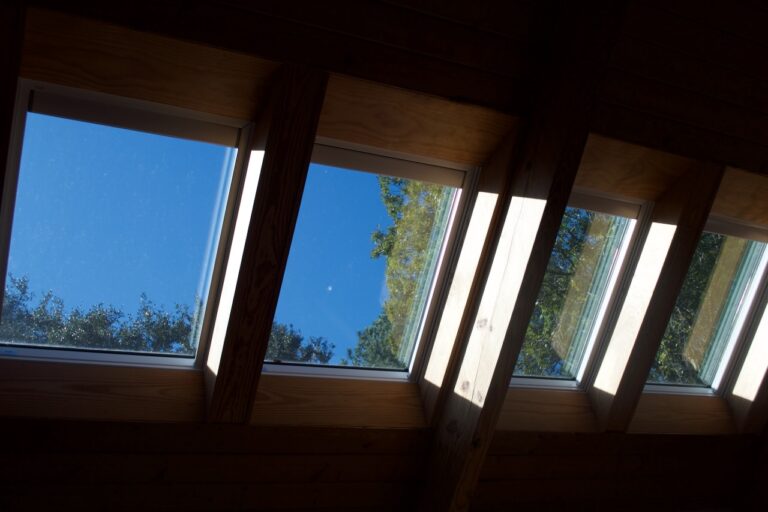
Besides the driveway views, our deck faces south for fine views of the forest. Right in front is an interesting group of trees squeezed together both above and below ground – a live oak and American holly. A few weeks after coming home from the Franke sub-acute care facility, while sitting out on the deck near dusk, two red-shouldered hawks perched on live oak trees nearby. And from in the house looking through the skylights allows for a view of part of the overstory of live oak, mockernut hickory, and loblolly pine. (By the way, one of my favorite books of the last few years is The Overstory by Richard Powers.) The more I observe and study our forest community, the greater the fund of knowledge I acquire.
26 thoughts on “Hiking to the mailbox”
Jan Snook
Thank you for bringing us back to appreciate where we are. There is so much beauty in each inch we allow to prosper and grow. Love the variety and the relationship between us and the earth.
You all have the only longleaf pine I have seen in our neighborhood, a fine tree.
Susan Raynor
I love your inventory of our trees and the history of how some trees came to us and how some came back after Hugo. Trees are so special to us, our children and grandchildren. We are rich with the trees surrounded us.
I’m happy to hear your recovery is still progressing! It’s nice that you live in such a nice place for your interests in nature. Keep up the good effort and your enjoyment in the world around you.
Love your observations on your recent “hike”. .. my hikes are currently shorter and slower allowing time for observation. A silver lining to what WAS a cloud.
Am glad you enjoyed THE NATURE OF OAKS. As an entomologist I found it fascinating and am optimistic that tree lovers would learn about life IN/ON our wonderful OAKS.
Keep adding distance to your mail box hike!
Yes, heading down Jibe Court a little, other views of the forest community.
Brandon Dawson
Another excellent post! Enjoyed learning that there are a few “family” trees on the property. I found myself laughing as I envisioned Santee proudly chomping on limbs on the cedar.
Come by and check out those “family” trees sometime.
Pam
I was just thinking about you this weekend and love opening up your post this Monday morning! Your nature walks to the mailbox highlights the beauty all around us if we take the time to slow down and appreciate our environment! Thank you for sharing these many discoveries and continued healing.
Glad I had it ready by Monday morning for you. Not looking like a good mailbox hike day, pouring right now.
Bonny Luthy
Thank you Bob for your wonderful posts! We are so grateful for the beauty in our neighborhood. When we first moved here we thought we only had pine trees. But as you pointed out, our woods are full of a variety of trees. I look forward to the day you can walk through our woods with us and help us identify the many different trees and shrubs we enjoy. Grateful for your progress and pray you continue to gain strength and mobility.
I so loved reading this, Bob- thank you for sharing it. I have perhaps a similar forest on our property on the opposite side of Charleston County and I was waiting for your mention of Privet. We have given up attempts to control it but it is literally everywhere. Also and related, The Overstory by Richard Powers is one of my all time favorite books and inspired by it, when our almost 4 year old granddaughter was born we commemorated the her birth by planting three Long Leaf Pines that are now about 15 feet tall!. I understand that when she is 30 they will start to produce pine cones, and I am hopeful she will see them. When her brother was born 2 years later, we similarly planted 3 black tupelo trees. They have not done as well but we are attending to them. Thanks again, Bob. -Sarah
Great commemoration to plant trees on the birth of your granddaughter, and fine trees, longleaf pine. No mention of privet, since I just focused on native flora. Glad we don’t have any of that on our property. Hope you have read some of Powers’ other books. Thanks for the comment, Sarah.
English Pearcy
I continue to appreciate your approach to recovery. Keep walking and keep writing! Thanks
Bob we discussed the other day my recent discovery of the ability to use the PICTURE THIS app to reveal the name 0f a tree by taking picture of the bark. So easy now, not having to pick out the leaves high in the canopy. Another way top put names on all the wonderful natural trees in the forest!
come over sometime and we can test the accuracy of PICTURE THIS.
Dana Bennett.
Love knowing the names of all the trees.
Thank you for the local inventory of trees and shrubs. Your awareness for detail is one of your gifts.
So glad you’re getting stronger and stronger.
You have what it takes to overcome set backs and we’re all proud of you.
PICTURE THIS sounds interesting and helpful.
Carry on and report back.❤️👍
Thanks Dana. We may test out PICTURE THIS today to see how accurate it is.
One of these days I will be able to make the hike to the Bennetts, but not yet. Have to take things one step at a time.

Thank you for bringing us back to appreciate where we are. There is so much beauty in each inch we allow to prosper and grow. Love the variety and the relationship between us and the earth.
You all have the only longleaf pine I have seen in our neighborhood, a fine tree.
I love your inventory of our trees and the history of how some trees came to us and how some came back after Hugo. Trees are so special to us, our children and grandchildren. We are rich with the trees surrounded us.
We are rich with our forest, for sure.
I’m happy to hear your recovery is still progressing! It’s nice that you live in such a nice place for your interests in nature. Keep up the good effort and your enjoyment in the world around you.
Take care,
Ray
Great opportunities for nature study.
Love your observations on your recent “hike”. .. my hikes are currently shorter and slower allowing time for observation. A silver lining to what WAS a cloud.
Am glad you enjoyed THE NATURE OF OAKS. As an entomologist I found it fascinating and am optimistic that tree lovers would learn about life IN/ON our wonderful OAKS.
Keep adding distance to your mail box hike!
Yes, heading down Jibe Court a little, other views of the forest community.
Another excellent post! Enjoyed learning that there are a few “family” trees on the property. I found myself laughing as I envisioned Santee proudly chomping on limbs on the cedar.
Come by and check out those “family” trees sometime.
I was just thinking about you this weekend and love opening up your post this Monday morning! Your nature walks to the mailbox highlights the beauty all around us if we take the time to slow down and appreciate our environment! Thank you for sharing these many discoveries and continued healing.
Glad I had it ready by Monday morning for you. Not looking like a good mailbox hike day, pouring right now.
Thank you Bob for your wonderful posts! We are so grateful for the beauty in our neighborhood. When we first moved here we thought we only had pine trees. But as you pointed out, our woods are full of a variety of trees. I look forward to the day you can walk through our woods with us and help us identify the many different trees and shrubs we enjoy. Grateful for your progress and pray you continue to gain strength and mobility.
I am ready to walk with you in your woods. Some afternoon this week?
I enjoyed reading this. Thank you for sharing!
Thanks Angie
Thanks, Bob, wonderful musings. It takes a long time to have a relationship with a tree . . . like some people. Thanks for sharing this.
Glad to hear from you Bill.
I so loved reading this, Bob- thank you for sharing it. I have perhaps a similar forest on our property on the opposite side of Charleston County and I was waiting for your mention of Privet. We have given up attempts to control it but it is literally everywhere. Also and related, The Overstory by Richard Powers is one of my all time favorite books and inspired by it, when our almost 4 year old granddaughter was born we commemorated the her birth by planting three Long Leaf Pines that are now about 15 feet tall!. I understand that when she is 30 they will start to produce pine cones, and I am hopeful she will see them. When her brother was born 2 years later, we similarly planted 3 black tupelo trees. They have not done as well but we are attending to them. Thanks again, Bob. -Sarah
Great commemoration to plant trees on the birth of your granddaughter, and fine trees, longleaf pine. No mention of privet, since I just focused on native flora. Glad we don’t have any of that on our property. Hope you have read some of Powers’ other books. Thanks for the comment, Sarah.
I continue to appreciate your approach to recovery. Keep walking and keep writing! Thanks
Thanks English.
Bob we discussed the other day my recent discovery of the ability to use the PICTURE THIS app to reveal the name 0f a tree by taking picture of the bark. So easy now, not having to pick out the leaves high in the canopy. Another way top put names on all the wonderful natural trees in the forest!
come over sometime and we can test the accuracy of PICTURE THIS.
Love knowing the names of all the trees.
Thank you for the local inventory of trees and shrubs. Your awareness for detail is one of your gifts.
So glad you’re getting stronger and stronger.
You have what it takes to overcome set backs and we’re all proud of you.
PICTURE THIS sounds interesting and helpful.
Carry on and report back.❤️👍
Thanks Dana. We may test out PICTURE THIS today to see how accurate it is.
One of these days I will be able to make the hike to the Bennetts, but not yet. Have to take things one step at a time.