Live oak
For some, southern magnolias are the tree most evocative of the South; for me live oak is the iconic Lowcountry tree.
Live oaks are native, occurring in the maritime forest, and represented well on the barrier islands. They grow along the Southeastern and Gulf coasts and up into the coastal plain.
They do well when planted, and are surprisingly fast growing. When planted in lining roads or drives as allees, create magnificent entrances to homes, often seen as leading up to plantation estates.
Live oaks have excellent characteristics. The wood is durable – resistant to splitting and rot. The trees are resilient to stormy weather: can withstand salt spray, and since the trees are more spread out than tall resist uprooting. Live oak is excellent as firewood. Trees can grow right on the edge of the marsh. Bulls Island suffered the epicenter of Hurricane Hugo’s fury: a majority of the loblolly pine trees were destroyed compared to 40% of the live oaks.
I have some personal experience related to the live oak’s resistance to splitting. Back in the 1970’s when living in Wilmington, NC, I used to gather with a group of friends in a back yard, and make individual attempts to split rounds of live oak with a splitting maul. This activity was entertaining as a spectator sport with good-natured encouragement and ribbing, and laughter at the live oak often winning the battle with the splitter, success only coming after multiple blows.
When splitting a sizable pile of live oak rounds with friends Chris and Bonny Luthy using their hydraulic splitter in my driveway, we would at times hear the groan of the splitter before the explosion of the oak as it came apart.
John Bartram, the colonial botanist, said about the tree “live oak (so-called for being an evergreen) is tougher and of a better grain than the English oak, and is highly esteemed for shipbuilding.” Estimates of the durability of live oak has been 5x that of the more common white oak in wooden vessels.
The live oak tree, due to its ability to grow to great size with curved limbs spreading out over a large area, is aesthetically distinctive and unmistakable with resurrection ferns growing on the horizontal branches and adorned with Spanish moss. It is not hyperbole to say these grand trees have a presence. To view a fine gallery of SC live oaks peruse the South Carolina Picture Project live oak page.
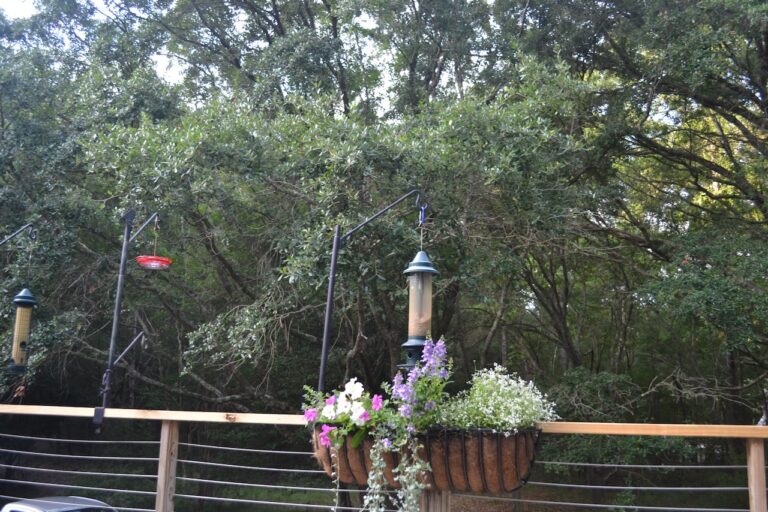
Live oaks are prized trees in anyone’s yard, and one in ours is most appreciated. Coming out of the ground in three trunks it has spread out over the open spaces in front of the house, its limbs reaching out toward the deck and providing perching for the birds waiting their opportunity to land and feast at one of our feeders.
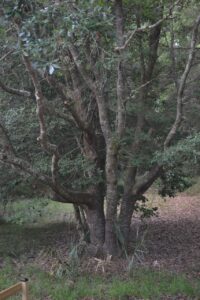
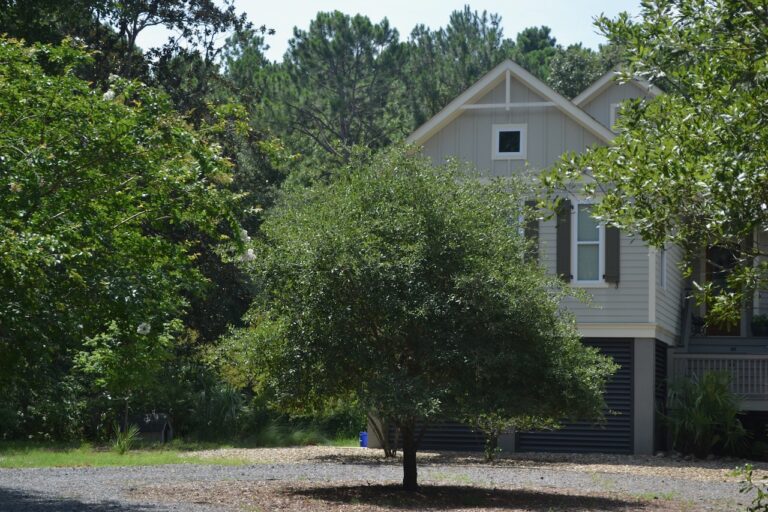
Our community, Romain Retreat, is populated with many live oaks, some planted by property owners. My friends Chris and Bonny Luthy planted a live oak in the center of a circular segment of their driveway in January of 2020; at that time the tree had a circumference at the base of 16 inches, and a height of 12 feet. Today it has a base circumference of 27 inches, and an estimated height of18 feet.
Bill and Gwen Reid, our neighbors in the past, named their grand live oak “Boomer”. Another oak located along their deck facing the marshes of Cape Romain acquired another name “Charlie’s oak”, related to the teasing by my father (Charlie) that the oak should be pruned or cut down to improve the view, an act that would have been anathema to the Reids.
Live oaks also make a substantial contribution to the ecology of one’s land. Doug Tallamy, in his book The Nature of Oaks, describes how oaks are our most essential trees. They support more life forms and interactions than any other local tree genus.
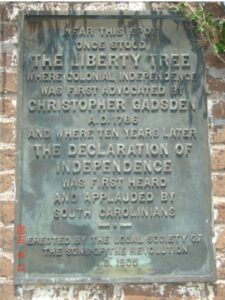
Individual grand live oaks due to size and age receive names related to their distinctiveness (Angel Oak, Deerhead Oak), associated with place (Middleton Oak, McLeod Oak), or history (Washington Oak at Hampton Plantation), or a more expansive history – a place where revolutionaries, the Sons of Liberty, would gather in Charleston starting in 1766 at the Liberty Oak. The bronze plaque for its location in Charleston reads: “Near this spot once stood the Liberty Tree where Colonial Independence was first advocated by Christopher Gadsden A.D. 1766 and where ten years later the Declaration of Independence was first heard and applauded by South Carolinians.”
[For a in-depth look at the history of this tree in downtown Charleston see Nic Butler’s account in the Charleston Time Machine https://www.ccpl.org/charleston-time-machine/remembering-charlestons-liberty-tree-part-1]
Live oaking
Live oak became recognized for its usefulness in shipbuilding. Northern shipbuilders sought this resource, stimulating the development of an industry. After the Revolutionary War ended, the new government saw the need to develop its navy. After Congress approved the Act of 1799 to provide the funding for the procurement of live oak timber, contracts were negotiated with several private land owners, including the owner of Bulls Island, S.C. at that time –Thomas Shubrick. Bulls Island was endowed with large stands of mature live oaks, and Shubrick hoped to make a substantial profit with this commission to provide the live oak timber for two 74-gun ships of the line. (At the same time Phineas Miller of Cumberland Island, GA contracted with the federal government to provide the live oak timber for four 74-gun ships of the line.) It was estimated it would take 680 mature trees to complete the framework for just one of these ships.
Shubrick initially attempted to use local labor for the task, but he found these workers did not have the required skills, and he shifted to employing experienced shipwrights from Massachusetts, eventually 65 from Newburyport. He added to the work force by contracting with local plantation owners for the labor of enslaved black carpenters, 40 in total.
The skilled Yankee laborers (known as live oakers) had to cut down the trees with felling axes, and then cut the rough pieces down to specific patterns, or molds, using hewing axes. Only a minority of the shipwrights had the skill to form the individual pieces. The foreman had the molds (patterns) and would identify which trees to cut down, and what part of the tree to harvest, utilizing the natural curved limbs of the live oak. The foreman had to have great skill to use his eye in making these calculations. Some of the required framework parts of the wooden ship included futtocks (ribs) and knees. The pieces could only exceed the dimensions of the molds by one inch in each direction so as not to increase the cost of freight in transporting these timbers back north to the shipyards on schooners. Some of the timbers, known as “sticks”, could be one hundred feet in length and weigh up to a ton.
The northern workers would not come south until after the “sickly season”. The work itself was very dangerous and challenging, and the entire enterprise had enormous difficulties. The live oak pieces were most heavy, and moving them to the landing required a special cart with very big wheels (7-12 feet in diameter) pulled by oxen, loading them on smaller vessels (lighters), and finally transport to and loading on the timber schooners. The oxen had to be transported by ship to the work sites. Despite the fact that the workers did not arrive in the south in late fall, there was still the presence at times of mosquitoes, biting flies, gnats, and ticks. The workers upon arriving on Bulls Island would fashion a primitive shack with a palmetto leaf roof for their shelter.
The workers upon felling trees would often find the downed timbers defective due to internal rot not observed from the tree’s exterior. Shubrick corresponded with Miller, and noted in one letter that of six trees out of ten recently harvested were not usable due to rot. Five of Shubrick’s Massachusetts shipwrights died on the island during this work period.
Shubrick’s work force was unable to complete the frame components of one ship of the line. The contract turned out to be a failure for Shubrick, and it was noted years later that much of the timber still lay on the ground. After his death in 1812, a court case relating to the contract was ongoing, and as late as 1825 his son, Navy Lieutenant Edward Shubrick, was still applying to the federal government for money owed to his family. Despite this disaster for the Shubricks live oaking continued on Bulls Island into the future, with one work crew documenting the harvest of trees there in 1841.
After Hurricane Hugo devastated the Lowcountry in 1989, with many live oaks downed, out of the disaster the U.S. Navy, in process of repairing the USS Constitution, found the premium timber for the rebuild.

Great post, Bob. Live oak trees are one of my many favorite trees. I enjoy each special tree on our land and in our neighborhood and in Charleston. They are sturdy, majestic and home to so many birds. Thank you for another great post!
Thank you. We are fortunate to have a number on our property, aren’t we?
Loved the post!! Suggest folks read THE NATURE OF OAKS by Douglas Tallamy
xoxo G
Yes, the Nature of Oaks is most informative.
Thank you Bob … your research and insights and wonderful writing are a gift. We look forward to our live oak continuing to grow and standing majestically in this beautiful neighborhood.
Your live oak is majestic already. Thanks for”sharing” it with this blog post and its readers.
Thanks for the background on live oaks. I love your tree as well as the flowers, birdfeeders and hummingbird feeders on the deck. What a wonderful place to sit back, relax and enjoy all the beauties of nature. Keep sharing!!
It is a great place, up in the tree at the deck level.
Hope you are still enjoying your birds
Great hearing from you again Bob. Very interesting live oak story. Keep up the good work. 👍
Thanks Don. Hoping you are well.
I loved the naming exercise our family did on my “new” old tree at our Holly Tree home. We might need an addendum post and photo for Zeb…
Yes, Zeb is a grand tree, and part of the family now.
Our neighborhood in Mt. Pleasant (Wakendaw Lakes) is essentially a live oak arbor. Hugo cleaned out most of the loblolly pines and many of the long leafs. Pecan trees left over from when the land was a pecan orchard have mostly died. Decorative trees like maples have died. But the live oaks remain! Over 30 years ago, our neighbors wisely replaced fragile pecan trees with young live oaks. Today we have a dramatic entrance boulevard covered by mature live oaks. Thank you neighbors!
Someone made a great decision about going with the live oaks. It may be time for a subdivision name change.
Love this post, Bob! I’ve been fascinated by the naval stores industry, and this has such great info!
Thanks, Bob. I understand live oak shipbuilding better now. I had wondered, now I know.
And thank you English.
My source for this live oaking information was Live Oaking: Southern Timber for Tall Ships, Virginia Steele Wood, Northeastern University Press. Boston:1981.
Had to use interlibrary loan for the reference. The book has great illustrations, but could not use them.